Smarter Property Inspections: How Technology, Consistent Standards and Professional Operatives Improve Property Maintenance
Property maintenance can become inefficient when inspections, photographs, repair notes and contractor updates are managed across separate systems.
A tenant may report an issue by telephone, photographs may be sent by email, inspection notes may be stored in spreadsheets, and repair updates may sit within individual inboxes. This makes it difficult for landlords, estate agents and housing providers to maintain a clear and consistent view of property condition.
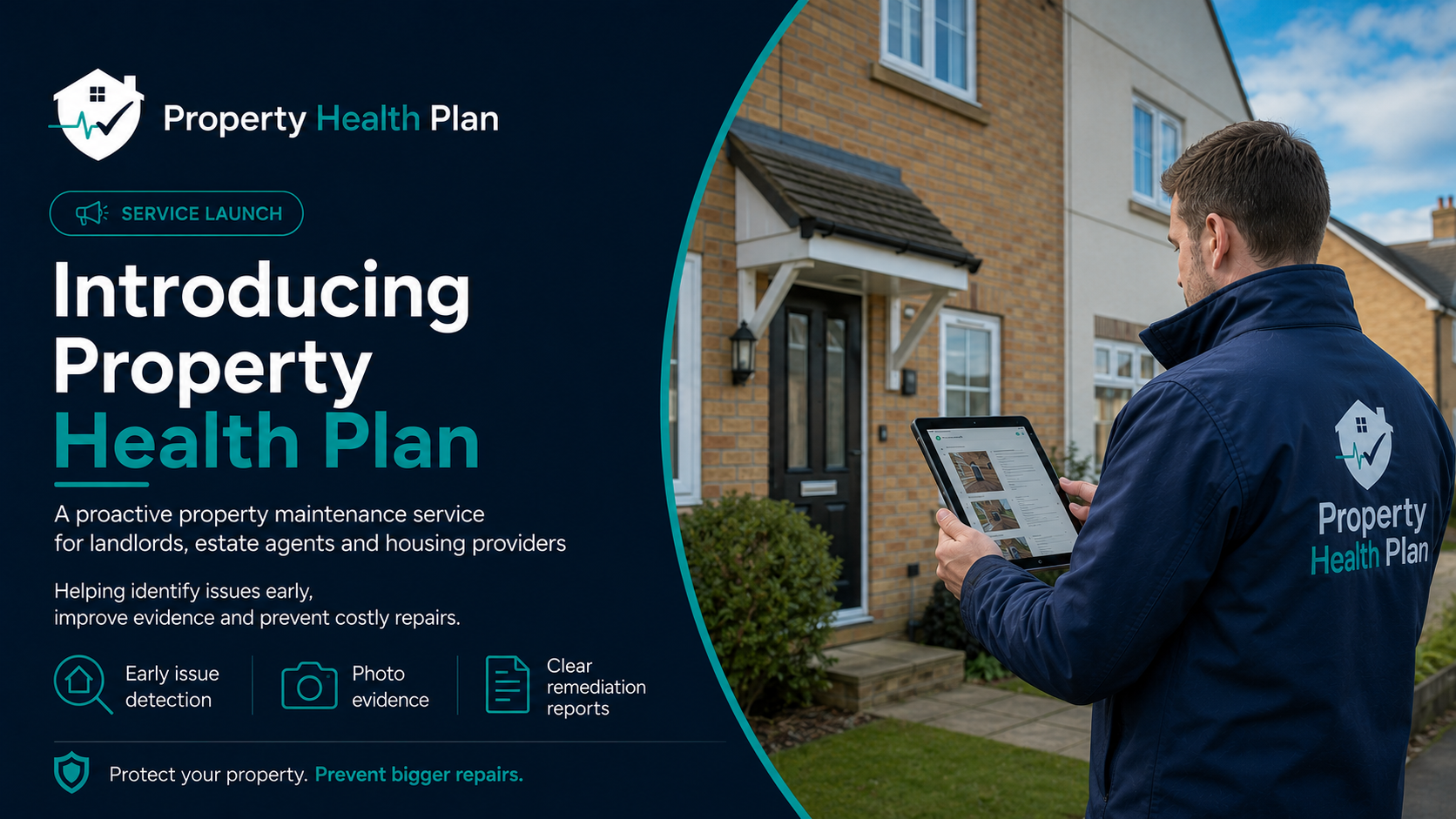
Property Health Plan brings together professional property inspections, standardised survey processes and purpose-built technology to create a more efficient and evidence-based approach to property maintenance.
The objective is straightforward: identify concerns earlier, reduce administration and give property owners and managers greater control over maintenance decisions.
Moving beyond reactive property maintenance
Traditional property maintenance is often driven by complaints or emergencies.
A leak is investigated after visible damage appears. Damp is addressed once mould has developed. A blocked gutter receives attention after water enters the property. By this stage, the original defect may already have caused wider damage.
A proactive inspection programme creates opportunities to identify visible concerns before they become urgent.
Scheduled property health inspections can help uncover issues such as:
- Minor plumbing leaks
- Damaged seals around baths and showers
- Poorly performing extractor fans
- Condensation and mould risks
- Blocked gutters and downpipes
- Deteriorating brickwork and pointing
- Damage around windows and doors
- Drainage concerns
- Signs of water ingress
- General building deterioration
Early identification allows repairs to be planned rather than handled only when they become emergencies.
Technology-led property inspections
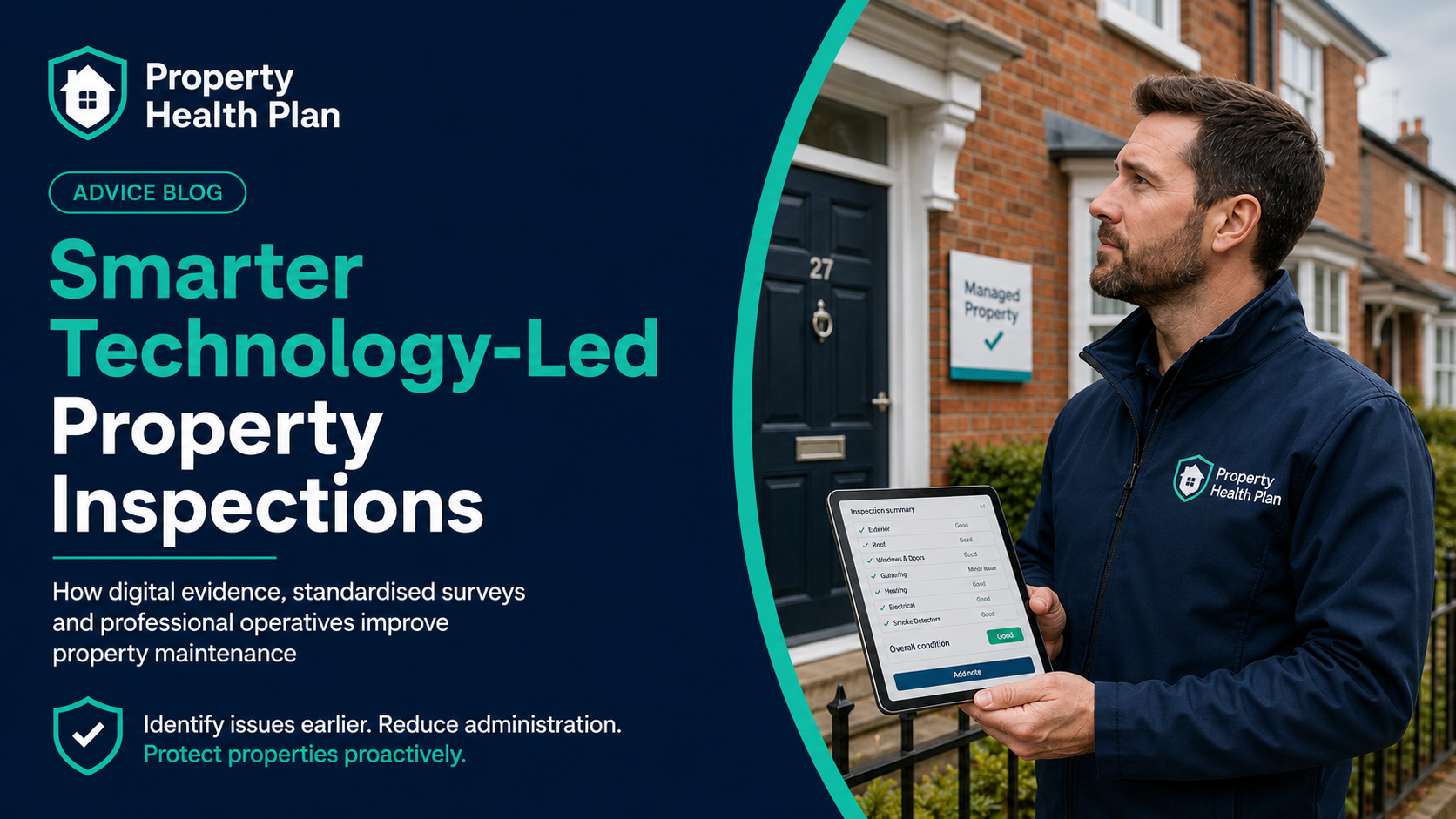
Property Health Plan uses a digital platform to manage the inspection process from property setup through to reporting and follow-up action.
Instead of relying on handwritten notes or disconnected photographs, inspection findings can be recorded digitally at the property.
This creates a more efficient process for operatives and administrators while providing customers with clearer information.
Technology-led inspections can support:
- Structured inspection forms
- Mandatory evidence requirements
- Digital photographs
- Property and room-level records
- Defect categorisation
- Remediation notes
- Priority and risk ratings
- Report generation
- Portfolio-level visibility
- Inspection scheduling and monitoring
Recording information directly during the visit can also reduce duplicate data entry and the risk of information being lost when it is transferred between different systems.
Consistent inspection standards
Consistency is essential when inspections are completed across multiple properties, locations and operatives.
Without a standardised process, one inspection may record significantly more detail than another. Photographs may vary in quality, terminology may be inconsistent, and important areas can be overlooked.
Property Health Plan inspections follow structured survey processes, evidence requirements and reporting procedures.
This helps ensure that each visit considers the same relevant property areas and that identified defects are recorded in a consistent format.
A structured inspection process may define:
- Which internal and external areas should be reviewed
- What questions must be answered
- When photographic evidence is required
- How defects should be described
- How risk and urgency should be recorded
- What remediation information should be provided
- Which findings require escalation
- What checks must be completed before a report is released
This consistency is particularly valuable for estate agents and housing providers managing larger portfolios, where reports need to be compared across different properties.
Professional and accountable operatives
Technology alone does not create a reliable property inspection service.
The quality of the outcome also depends on the people carrying out the visits.
Property Health Plan combines its digital platform with professional operatives who follow the required inspection process and evidence standards.
The platform can support the management of operative information such as:
- Experience and relevant qualifications
- Accreditation records
- Geographic coverage
- Availability
- Assigned workloads
- Completed inspections
- Quality-review outcomes
- Supporting documentation
- Expiry dates for relevant credentials
This creates greater accountability and helps ensure that work is allocated to suitable operatives.
It also provides a clearer record of who attended the property, when the inspection took place and what evidence was collected.
Digital photographic evidence
A written description of a defect can be open to interpretation.
For example, a note stating that there is “some damp near the window” does not explain the extent of the issue, the exact location or whether the condition is changing.
Photographic evidence provides greater context.
Property Health Plan inspection records can include:
- Wider photographs showing the location of the issue
- Close-up photographs showing the defect
- Images of the surrounding areas
- Photographs of relevant equipment or fittings
- Before-and-after repair evidence
- Images from repeat inspections
Clear photographs can help landlords, agents and contractors understand the concern without relying solely on a short written description.
They also create a useful condition history that can be reviewed over time.
Faster reporting and reduced administration
Manual reporting can create delays.
Inspection notes may need to be typed up, photographs downloaded and renamed, reports formatted, emails prepared and records uploaded into another system.
A purpose-built platform can streamline this process by using the information captured during the inspection to create a structured digital record.
This can reduce:
- Repetitive data entry
- Manual report preparation
- Time spent searching for photographs
- Delays between inspection and reporting
- Inconsistent report layouts
- Email-based document management
- The risk of missing information
Faster reporting means that maintenance teams can review findings and begin arranging the required action sooner.
Clearer maintenance priorities
Not every defect requires the same response.
A minor cosmetic issue may be suitable for monitoring, while an active leak or significant water-ingress concern may require urgent action.
Property Health Plan helps turn inspection findings into clearer maintenance priorities.
Defects can be categorised according to factors such as:
- Type of issue
- Location
- Severity
- Risk
- Recommended response
- Urgency
- Monitoring requirement
- Responsible party
This helps customers distinguish between:
- Immediate concerns
- Short-term repairs
- Planned maintenance
- Items requiring specialist investigation
- Lower-risk issues suitable for monitoring
Clearer prioritisation supports better use of budgets and maintenance resources.
Better visibility across property portfolios
Managing one property can involve several maintenance records. Managing dozens or hundreds can make it difficult to understand where the greatest risks sit.
Portfolio visibility is therefore one of the most important benefits of a structured digital inspection service.
A portfolio-level view can help customers see:
- Which properties have upcoming inspections
- Which inspections are overdue
- Where higher-risk defects have been identified
- Which repairs remain outstanding
- Which properties have recurring concerns
- Where damp or mould risks are concentrated
- Which reports are awaiting review
- How property condition is changing over time
This allows teams to move beyond individual issue management and take a more strategic view of the portfolio.
Supporting landlords
For landlords, Property Health Plan provides a clearer picture of property condition between tenancy changes and major repair events.
The service can help landlords:
- Identify defects before they become more expensive
- Maintain photographic condition evidence
- Receive structured inspection reports
- Understand recommended next steps
- Plan repairs and maintenance budgets
- Monitor recurring issues
- Maintain a clearer property history
- Demonstrate a proactive approach to property management
This can be particularly valuable for landlords who do not live close to their properties or who rely on managing agents and contractors to oversee maintenance.
Supporting estate and managing agents
Estate and managing agents often coordinate maintenance across properties owned by different landlords.
Each landlord may have different expectations, budgets and levels of involvement.
A consistent inspection service can help agents provide a more structured property-management offering.
Benefits may include:
- Reduced time investigating maintenance complaints
- Clearer evidence to share with landlords
- Faster instruction of contractors
- More consistent reporting
- Better visibility across managed portfolios
- Clearer prioritisation of higher-risk properties
- A stronger additional service for landlord clients
- Improved records of inspections and completed repairs
Property Health Plan can therefore support both operational efficiency and service differentiation.
Supporting social housing providers
Social housing providers may manage large and geographically dispersed portfolios with significant inspection, repair and evidence requirements.
A technology-led approach can help create greater consistency across those homes.
Potential benefits include:
- Standardised property-condition inspections
- Clear evidence of reported defects
- Earlier identification of damp and mould risks
- Improved repair prioritisation
- Portfolio-level risk reporting
- Better records of visits and actions
- Stronger contractor instructions
- More transparent communication
- Clearer evidence to support complaint handling
A structured record can also help teams demonstrate what was observed, what action was recommended and how the issue progressed.
Improving communication between everyone involved
Property maintenance can involve landlords, tenants, managing agents, housing teams, operatives, contractors and specialist professionals.
Communication becomes difficult when each party is working from different information.
A structured inspection report provides a shared reference point.
It can clearly record:
- What was inspected
- What was observed
- Where the concern is located
- What photographs were taken
- How urgent the issue appears
- What remediation is recommended
- Whether specialist advice is needed
- What should be monitored
- Whether repairs have been completed
This reduces ambiguity and helps everyone understand the next steps.
Quality review before reports are released
Inspection information should not necessarily be issued without review.
Property Health Plan can support an internal review and approval process before reports are released to customers.
This provides an opportunity to check:
- Whether required questions were answered
- Whether photographs are clear and relevant
- Whether defect descriptions are understandable
- Whether remediation notes are appropriate
- Whether urgent issues have been escalated
- Whether the report meets the required standard
Quality review helps maintain consistency and gives customers greater confidence in the information they receive.
Creating a long-term property condition record
The value of an inspection increases when it forms part of a continuing property history.
Repeat inspections can help show whether:
- A crack remains stable or becomes wider
- Damp staining continues to spread
- A repaired leak has returned
- Mould reappears after treatment
- Pointing continues to deteriorate
- A gutter defect has been resolved
- Recommended repairs have been completed
- The overall condition is improving or declining
This turns individual inspection reports into a longer-term maintenance tool.
What Property Health Plan does not replace
A property health inspection is designed to identify visible concerns, document evidence and recommend appropriate next steps.
It does not replace specialist inspections or statutory checks where these are required.
Issues involving electrical systems, gas installations, structural movement, asbestos, fire safety or other specialist areas should be referred to appropriately qualified professionals.
The purpose of Property Health Plan is to improve early identification, evidence and maintenance coordination, not to overstate the scope of a visual condition inspection.
A more efficient way to protect properties
Property Health Plan brings together three important elements:
Technology provides structured digital inspections, faster reporting and portfolio visibility.
Consistent standards create clearer, comparable evidence across every property.
Professional operatives provide the on-site experience required to identify and document visible concerns.
Together, these elements help landlords, estate agents and housing providers manage properties more efficiently and proactively.
The result is less fragmented information, clearer maintenance priorities and a better opportunity to address small issues before they become larger repairs.
Identify issues earlier. Reduce administration. Protect properties proactively.
Visit propertyhealthplan.co.uk to learn more.